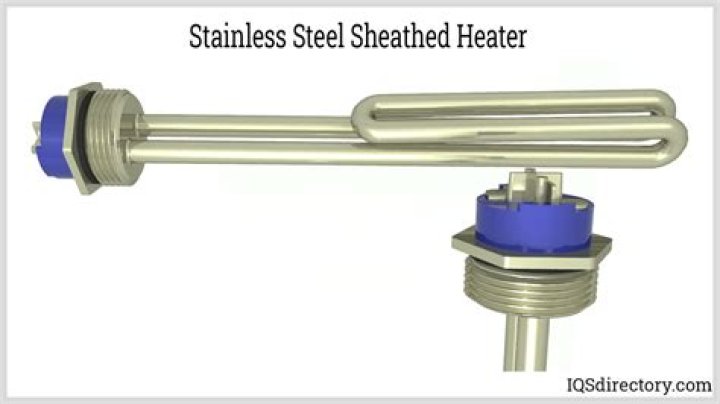
All water heater electrical elements are rated by the amount of power they can emit. This power is described as wattage or watts. Displayed on the elements packaging is a number followed by the word “watts”. A typical value for a 220 VAC hot water heater would be an element rating of 3500 watts.
What is the kilowatt rating of an electric furnace rated at 240 V and 30 A?
What is the kilowatt rating of an electric furnace rated at 240 volts and 30 amps? 240 V × 30 A = 7,200 W, which is 72kW.
What makes a good heating element?
The most important heating element characteristics are sufficient resistivity, high oxidation resistance, low-temperature coefficient of resistance, high toughness, and high melting point.
What is the current draw of a 2000 W baseboard heating unit rated at 240V?
Baseboard Power:Amp Draw (at 120V):Amp Draw (at 240V):1,000 W8.33 amps4.17 amps1,500 W12.5 amps6.25 amps2,000 W16.67 amps8.33 amps3,000 W25 amps12.5 ampsHow many ohms should a heating element have?
Check the resistance of the upper heating element using a multimeter. Measure the resistance between the two screw terminals on the upper heating element. A good element will have a resistance between 5 and 25 Ohms.
How many kWh does it take to heat a house?
A ‘typical’ home in a mild climate uses between 5,000 kWh and 30,000 kWh of energy a year for heating.
How many ohms should a 3000 watt water heater element have?
Elements do have some resistance, so a reading of 10-16 ohms is normal, with higher ohm readings for 3,500 watt elements and lower readings for 5,500 watt elements.
What size electric furnace do I need for a 2000 square foot home?
Room SizeElectric Furnace Size for Hot Climate (Zone 1&2)Electric Furnace Size for Warm Climate (Zone 3)1,500 sq ft14 – 16 kW16 – 18 kW1,600 sq ft15 – 17 kW17 – 19 kW1,800 sq ft16 – 19 kW19 – 22 kW2,000 sq ft18 – 21 kW21 – 24 kWWhen checking an electric furnace The technician should check?
If the furnace has one or more broken heating elements or one or more fusible links open, what should the technician do? The technician should check the furnace airflow. A visual inspection might reveal a broken heating element, an open fusible link, and a cracked ceramic insulator.
How much does it cost to run a 1500-watt heater for 24 hours?Electric Heater Wattage:Running Cost (Per Hour)Running Cost (For 24 Hours)750 Watts$0.10$2.401,000 Watts$0.13$3.121,250 Watts$0.17$4.081,500 Watts$0.20$4.80
Article first time published onHow many electric heaters can I run on a 20 amp breaker?
A 20-amp breaker can support any combination of heaters up to a total of 3,840 watts. For example, using a single thermostat, the breaker could support two 1500-watt heaters or three 1000-watt heaters.
What type of thermostat is typically used with electric baseboard heater?
Line-voltage thermostats are powered directly by a standard 120-volt or 240-volt circuit—the same circuit that powers a permanent electric heater. They are primarily used for electric resistance heating systems, such as electric baseboard heaters and in-wall heaters.
Do heating elements have high resistance?
Heating elements don’t have a high resistance: for example a 1kW 220v heating element will have a resistance around 50 Ohms and a 2kW one will be about 25Ohms. If you’re in a country using 110V then a 2kW element will have a resistance of only 6.05 Ohms.
How do resistive heaters work?
A heating element converts electrical energy into heat through the process of resistive (otherwise known as Joule heating). The electric current passing through the element encounters resistance, which produces heat.
What are resistive heaters made of?
Resistive heaters can be made of conducting PTC rubber materials whose resistivity increases exponentially with increasing temperature. Such resistive heaters produce high power they are cold and rapidly heat up to a constant temperature.
How many ohms should a 3500 watt element have?
A 3,500-watt element should register 16 ohms, a 4,500-watt element should register between 12 and 13 ohms, and a 5,500-watt element should register between 10 and 11 ohms. Replace the element if it does not register on the multimeter. Leave one of the probes touching one of the screws on the element face.
What is the resistance of an element?
Ohms law states that V=IR or I=V/R. Substitute V/R for I in the power formula gives us P=V/R*V or V*V/R, so resistance of the element should be the voltage squared divided by the power.
What should the Ohms be on a hot water heater element?
If the heating element is functioning properly, the multimeter should read between 10 and 30 ohms. If there is a very low reading or zero reading, the heating element isn’t working and must be replaced. If your water heater has two heating elements, check the second element in the same manner.
What is the resistance of a 3kw element?
a 3kw heater is 13A, so R=V/I, R=230/13=17.69ohms. a 6kw will be 1/2 that. bear in mind that the cold resistance will be a bit lower.
Are upper and lower water heater elements the same?
Upper and lower heating elements are identical, and the temperature is regulated by the upper and lower thermostat and high limit device. Electric water heater elements can be different in size, but the most common is 12″ (300 mm).
Is 50 kWh a day a lot?
This too varies depending on the size of the solar array you’ve installed on your home, where you live, the weather, and many other factors. But since most homes are comparable enough in size and we can’t control the weather, 50 kWh per day is a good number to use, though maybe a bit on the high end for some homes.
How many kWh per day is normal?
According to the EIA, in 2017, the average annual electricity consumption for a U.S. residential home customer was 10,399 kilowatt hours (kWh), an average of 867 kWh per month. That means the average household electricity consumption kWh per day is 28.9 kWh (867 kWh / 30 days).
What consumes the most electricity in your house?
- Air Conditioning & Heating. Your HVAC system uses the most energy of any single appliance or system at 46 percent of the average U.S. home’s energy consumption. …
- Water Heating. …
- Appliances. …
- Lighting. …
- Television and Media Equipment.
What is the first thing a technician should do before working on an electric furnace?
The first thing to check is the breaker. Make sure that the unit is receiving power. Some electric heat pumps have a defrost condition in which the unit runs through a defrost cycle when the temperature is under 40 degrees. Once this cycle has run its course, the heating should turn on again.
Which of the following temperature ratings is appropriate for replacement wiring in an electric furnace?
All replacement wiring used in an electric furnace must have a rating of 10f degrees C with an AWM type appliance wire rating.
Do electric furnaces have Btu ratings?
Electric furnaces are made in a range from about 10kW/h to 25kW/h. Because each kilowatt equals 3,400 BTUs, that translates to 34,000 to 85,000 BTUs. In this table, the Unit Only price is based on a 20kW/h unit, which is the average size installed in the United States.
Is it cheaper to heat your house with gas or electric?
Less expensive to operate: Almost everywhere in the country, natural gas is significantly cheaper than electricity. If you live in a cold climate and run your heater a lot during the winter, a gas furnace can save you money over the long run.
Are new electric furnaces more efficient?
More efficient, but costs more to run While electric furnaces are far more efficient at converting their energy source (electricity) into heat than other types of furnaces, this efficiency is counterbalanced by the market prices of each energy source.
Do small electric heaters use a lot of electricity?
Even though they are typically small in size, and often touted as 100% efficient, electric space heaters use a lot of electricity. Most space heaters use on average 1,500 Watts of electricity and cost about 15¢ an hour to operate.
Do plug in radiators use a lot of electricity?
Are electric radiators cheap to run? It’s stated that electric radiators are 100 per cent efficient. This is because they use 100 per cent of the electricity provided to heat a room and so they are an energy-efficient way to heat your home.
Are oil filled electric heaters more efficient?
Oil heaters are more energy-efficient than electric heaters. They retain heat very well and once they hit the desired temperatures, they switch off automatically. This, in turn, can save you a ton of energy, using low power to maintain the warmth.