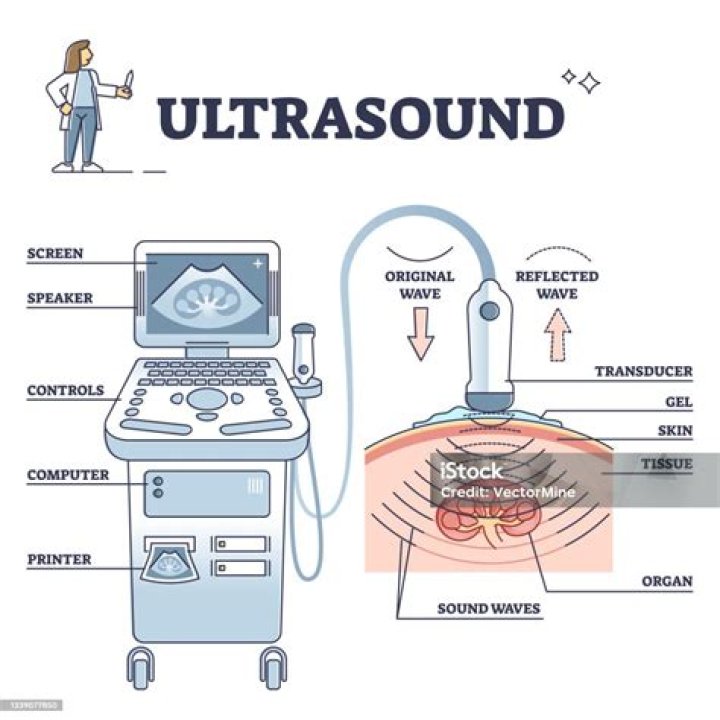
Absorption of ultrasound is the process of conversion of vibrational energy into heat. In biological soft tissues, the absorption coefficients are roughly proportional to the frequency; typically α = 1 dB cm−1 MHz−1.
How are ultrasound waves transmitted?
Ultrasonic waves are sound waves whose frequencies are higher than those of waves normally audible to the human ear. The angular frequencies of the ultrasonic waves produced in laboratories lie from about 105 sec−1 to about 3 × 10⁹ sec−1, the former value representing the limit of audibility of the human ear.
How does an ultrasound wave work?
Also known as sonography, ultrasound imaging uses a small transducer (probe) to both transmit sound waves into the body and record the waves that echo back. Sound waves travel into the area being examined until they hit a boundary between tissues, such as between fluid and soft tissue, or soft tissue and bone.
What happens to ultrasound waves?
When used in an ultrasound scanner, the transducer sends out a beam of sound waves into the body. The sound waves are reflected back to the transducer by boundaries between tissues in the path of the beam (e.g. the boundary between fluid and soft tissue or tissue and bone).Can ultrasound waves be absorbed?
This is due to the fact that ultrasound can be transmitted through soft tissue, but is mostly reflected when it comes into contact with more dense material such as bone. Any ultrasound that is not reflected will be absorbed by the body. Doctors also use ultrasound to monitor blood flow and destroy kidney stones.
Can ultrasound pass through glass?
Ultrasonic sound waves do not penetrate solid objects well. These include items such as: Glass doors and windows. Solid wood or concrete fences.
How does absorption cause ultrasound attenuation?
Absorption. This is the main factor causing attenuation of the ultrasound beam. The higher the frequency of the sound wave, the greater the amount of absorption that will occur. … The majority of the lost energy will cause a rise in temperature of the tissue through which the sound is traveling.
Why ultrasound can pass even through solids?
At such high frequencies it is very difficult for a sound wave to propagate efficiently; indeed, above a frequency of about 1.25 × 10¹³ hertz it is impossible for longitudinal waves to propagate at all, even in a liquid or a solid, because the molecules of the material in which the waves are traveling cannot pass the …Can humans hear ultrasound waves?
Ultrasound is the name given to sound waves that have frequencies greater than 20,000Hz (20 kHz). This is above the normal hearing range for humans, so we cannot hear ultrasound.
Does ultrasound travel through air?The sound frequency used in ultrasound does not propagate through air. The energy rapidly dissipates and the energy is therefore not transfered into the tissue, nor are the weakened waves coming back from the tissue received by the pizio electric detectors.
Article first time published onDoes bone absorb or reflect ultrasound?
Physics of Ultrasound When ultrasound energy is transmitted into biologic tissue, the majority is absorbed; however, a small amount is reflected back to the transducer. … Hence, bone and air, when adjacent to soft tissues such as the heart, create poor acoustic windows for ultrasound transmission.
Does bone absorb or reflect sound waves How does this affect ultrasound images?
When the sound waves encounter a tissue that absorbs or transmits the sound, a wave is reflected back to the probe. … Rather, it detects sonotransmission (the passage or reflection of sound). Highly dense tissues such as bone or kidney stones readily reflect echoes and, therefore, appear bright white on an ultrasound.
What are the uses of ultrasound waves?
Ultrasound imaging uses sound waves to produce pictures of the inside of the body. It helps diagnose the causes of pain, swelling and infection in the body’s internal organs and to examine an unborn child (fetus) in pregnant women. In infants, doctors commonly use ultrasound to evaluate the brain, hips, and spine. .
Is ultrasound only for pregnancy?
Ultrasounds are only necessary if there is a medical concern. As noted above, ultrasounds enable your healthcare provider to evaluate the baby’s well being as well as diagnose potential problems. For women with an uncomplicated pregnancy, an ultrasound is not a necessary part of prenatal care.
Are ultrasound waves transverse or longitudinal?
Longitudinal wave and transverse wave Our ultrasonic processing machine mainly uses the longitudinal wave.
What is ultrasound scattering?
Scattering occurs when a sound wave strikes a structure with a different acoustic impedance to the surrounding tissue and which is smaller than the wavelength of the incident sound wave.
What materials can ultrasound penetrate?
Solid materials are very good at ultrasound transmission, as long as they are not filled with fillers or oils. Polystyrene, glass, PMMA and others are particularly good.
What Happens When ultrasound waves travel from air into tissue?
As the ultrasound wave travels through one medium or tissue into another medium or tissue, a change in acoustic impedance occurs. … The difference in acoustic impedance between two tissues accounts for the amount of reflection that will occur at the tissue border.
Why are ultrasound waves longitudinal?
Ultrasound tomography Longitudinal or compression waves are defined as waves where the particle motion is in the same direction in which the wave is propagating.
Can ultrasound be destructive?
Although Ultrasound cannot be heard by humans, at high decibels it can still cause direct damage to human ears. Ultrasound in excess of 120 decibels may cause Hearing damage. Exposure to 155 decibels causes heat levels that are harmful to the body. 180 decibels may even cause death.
How attenuation affects the production of ultrasound image?
The attenuation processes have the effect of reducing the intensity of the ultrasound beam as it traverses the tissues. The intensity varies not only with the type of medium, but also with distance within a specified medium.
Can ultrasound penetrate walls?
Ultrasonic waves behave more like light than sound. … Ultrasound cannot penetrate solid surfaces (walls, floors, ceilings) or travel around corners. This is why you need a unit for each affected room.
Can ultrasound see through walls?
Ultrasound can, and does, penetrate walls, but you can’t hear it. Higher frequencies tend not to excite relatively massive structures, e.g. sheet rock. Simple Answer: For the same reason that a fired bullet can pass through your body while a rock cannot.
Can ultrasound penetrate the skull?
The acoustic window commonly used in transcranial examination of the MCA is the temporal bone, which is the thinnest portion of the skull allowing maximum ultrasound penetration.
Why do people not hear ultrasounds?
An ultrasound is not a unique type of sound, therefore, but is classified differently due to the fact that humans cannot hear it. Ultrasounds have a frequency greater than 20 kHz, which is beyond the frequency limit of sounds that humans are able to hear.
Why can I hear dog whistles?
I can, too. It’s called hypersensitive hearing. When you’re younger you’re more apt to being able to hear them (like that ringtone teens use in school because their teachers can’t hear it), as the range lowers as people age. Some of us just have such sensitive hearing, though, that we never lose that range.
Why can I hear ultrasonic?
Ultrasonic hearing is a recognised auditory effect which allows humans to perceive sounds of a much higher frequency than would ordinarily be audible using the inner ear, usually by stimulation of the base of the cochlea through bone conduction.
What does ultrasonic waves carry more?
Answer is “both frequency and energy“
Can ultrasound travel in a vacuum?
The ultrasonic waves cannot travel through vacuum. These waves travel with speed of sound in a given medium. Their velocity remains constant in homogeneous media. These waves can weld certain plastics, metals etc.
What are ultrasonic vibrations?
SUMMARY. Ultrasonic vibrations are sound waves of frequencies above the audible range. They are subject to the same general physical laws as ordinary sound. Their high frequency and short wavelength make them capable of many uses that depend on the transmission of energy and on directional control of this trans mission …
Why is fluid black on ultrasound?
On sonography imaging liquids appear black because they are “anechoic”. It means that the ultrasound wave goes through them without emitting any return echo .