The combined system of you + elevator has two forces, a combined force of gravity and the tension in the cable. Consider the normal force acting on you from the elevator: N = mg if the elevator is at rest or moving at constant velocity. N = mg + ma if the elevator has an upward acceleration.
Why do you feel heavier in an elevator going up physics?
If you stand on a scale in an elevator accelerating upward, you feel heavier because the elevator’s floor presses harder on your feet, and the scale will show a higher reading than when the elevator is at rest. … The force exerted by the scale is known as apparent weight; it does not change with constant speed.
Why does normal force change in an elevator?
From Newton’s second law F=ma, acceleration requires a force proportional to mass. So when the elevator is accelerating upwards, it must not only oppose gravity but provide extra force for the upward acceleration. This requires an increased normal force.
How does gravity work in an elevator?
This can also make you feel lighter: when the elevator slows down, you need to slow down with it. But gravity is always pulling you down, so for you to slow down, the floor needs to push up on you less, so gravity can slow you down. Since the floor pushes on you less, you feel lighter.What is normal force in physics?
The normal force is the support force exerted upon an object that is in contact with another stable object. For example, if a book is resting upon a surface, then the surface is exerting an upward force upon the book in order to support the weight of the book.
What force that the elevator scale reads?
The scale reads the Normal force, so it reports your weight as greater than it was at rest. The same two forces are at work as when the elevator was accelerating up. The scale will read the Normal force which is less than it was at rest.
How does acceleration work in an elevator?
This is an application of Newton’s second law to the forces felt in an elevator. If you are accelerating upward you feel heavier, and if you are accelerating downward you feel lighter. If the elevator cable broke, you would feel weightless since both you and the elevator would be accelerating downward at the same rate.
Why does your weight decrease going down an elevator?
So since the elevator is accelerating downward, the force that the elevator is applying to your feet decreases. Your weight (force of Earth’s gravity pulling on your mass) is still the same, so you have unbalanced forces, and your body starts accelerating downward as well.How does Newton's 3rd law of motion affect your motion in an elevator?
Since your true weight remains the same, the net force arises because the elevator exerts a smaller normal force on you which is matched from Newton’s Third Law by an equal force downwards on the elevator (this downwards force is your apparent weight measured by weighing scales I believe).
How does an elevator slow down?When the velocity and acceleration are in different directions, the elevator slows down.
Article first time published onWhat happens if you jump on an elevator?
Jumping in an elevator can sound fun, but it is often not worth the effort. Individuals may find that they can hop around with no ill effects, which may result in damages under the surface of your system. In some instances, causing a large jolt can cause your elevator cab to halt, necessitating rescue measures.
Would a space elevator work?
A space elevator is possible with today’s technology, researchers say (we just need to dangle it off the moon) Space elevators would dramatically reduce the cost of reaching space but have never been technologically feasible.
What will the balance read if the elevator cable breaks?
If the elevator cable breaks, the elevator, the balance and the person standing on the balance would all be subjected to a free fall. Then, the person would no longer be exerting any force on the balance and consequently the normal reaction would be zero. Hence, the reading shown by the balance would be zero.
What two forces act on you while you are in a moving elevator when are these forces of equal magnitude and when are they not?
The two forces acting on a person when he is moving in an elevator is the force of gravity and the normal force by the elevator. The two forces are of equal magnitude, and the elevator is static or moving with constant velocity. Their magnitudes are unequal when the elevator is accelerating upward or downward.
When a person is riding on an elevator which is accelerating downward the normal force pushing up on them is less than their weight?
If the elevator accelerates upward, a is positive, and the equation shows that the apparent weight is greater than the true weight. If the elevator accelerates downward, a is negative, and the apparent weight is less than the true weight. If the elevator falls freely, , and the apparent weight is zero.
Why does normal force decrease as angle increases?
Putting “Friction on an Incline” in Conceptual terms: With an incline, the force of gravity is not perpendicular to the surface. As the angle of the incline is increased, the normal force is decreased, which decreases the frictional force. The incline can be raised until the object just begins to slide.
What does FF mean in physics?
Force of Friction (Ff) Force that opposes the motion of an object.
What is 100 N to the left?
The net force is 100N to the left. The greater force always overcomes the lesser force. In this case the rope accelerates to the left.
Is gravity a force?
Gravity is most accurately described by the general theory of relativity (proposed by Albert Einstein in 1915), which describes gravity not as a force, but as a consequence of masses moving along geodesic lines in a curved spacetime caused by the uneven distribution of mass.
How fast do elevators accelerate?
Let’s start with the turtle like speed of most elevators you will find; believe it or not, most elevators are designed to travel at a blazing 100 to 200 feet per minute or between 1.14 and 2.27 miles per hour for buildings 10 stories or less.
How much does an elevator weigh?
For a passenger elevator, it usually between 100% and 150% of the rated capacity – the capacity sign will be in the elevator. These numbers are usually somewhat lower for freight elevators. So a passenger elevator with a capacity of 1000kg will typically weigh somewhere between 1000kg and 1500kg.
What is the book's speed relative to you when it hits the elevator floor?
True, the velocity of the book when it hits the floor relative to the building is about 7.85 m/s, but the book will actually hit the floor of the elevator at approximately 4.85 m/s (relative to the floor).
What is the behavior of light when the elevator maybe accelerating upward or maybe acted by gravity?
Since the accelerated elevator moves up during the time light travels across the elevator, the beam of light strikes low, seeming to the person to bend down. (Normally a tiny effect, since the speed of light is so great.)
When an elevator is moving upward the apparent weight of a body inside elevator?
So, when a lift accelerates upwards, the apparent weight of the person inside it increases. So, when a lift accelerates downwards, the apparent weight of the person inside it decreases. R = m(g – g) = 0. Thus, the apparent weight of the man becomes zero.
What is the force on a 1000 kg elevator that is falling freely under the acceleration of gravity?
The only force on it is its weight, w=9800N .
Does your mass change in an elevator?
The mass of an object does NOT CHANGE in a moving elevator, it is the weight which changes. The mass of an object does NOT CHANGE in a moving elevator, it is the weight which changes. You can see that the scale reads higher than your normal “weight” m because “a” is positive (m and g are always positive).
Would your weight change in an elevator?
When the elevator is moving, we will weigh our normal weight. Since we are already moving at the same speed as the elevator (up or down), nothing is affecting us to change our weight. … So for a short time, we are pushed into the floor more and our weight goes up. The same thing works when the elevator starts moving.
Why do we float in a falling elevator?
You’re right, gravity is pulling you down. But it’s pulling the floor of the elevator down too. And it pulls the floor of the elevator down with the same acceleration as it pulls you down. So you “float” because everywhere around you has the exact same acceleration of 9.81 m/s/s as you do.
How do elevators work?
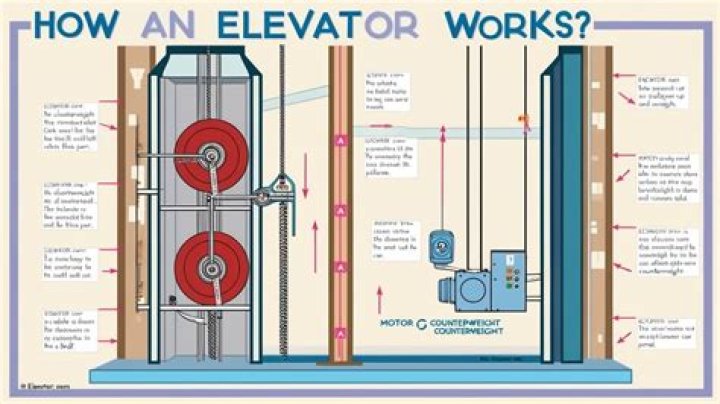
Most buildings that are taller than four stories use traction elevators. A motor at the top of the shaft turns a sheave—essentially a pulley—that raises and lowers cables attached to the cab and a counterweight. … Faster elevators are gearless; the sheave is coupled directly.
What is a free falling elevator?
3. Because you’re free free falling: In a falling elevator, you are in free fall relative to the car; in other words, you feel weightless and experience no force pulling you toward the floor.
Has anyone died in a falling elevator?
On 22 August 2019, 30-year-old Samuel Waisbren was crushed to death at an apartment building in New York City when the elevator which he was trying to exit suddenly descended. Five other people were trapped in the elevator and were later rescued by firefighters.