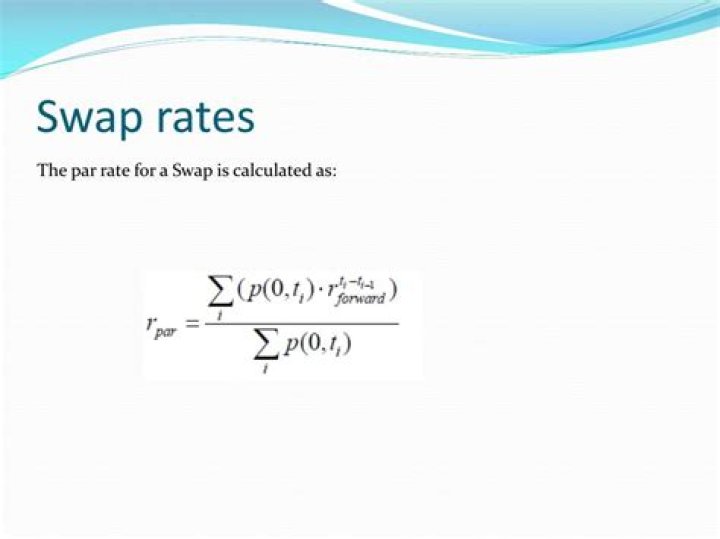
Formula to Calculate Swap Rate It represents that the fixed-rate interest swap, which is symbolized as a C, equals one minus the present value factor that is applicable to the last cash flow date of the swap divided by the summation of all the present value factors corresponding to all previous dates.
How does interest swap work?
With an interest rate swap, the borrower still pays the variable rate interest payment on the loan each month. … Then, the borrower makes an additional payment to the lender based on the swap rate. The swap rate is determined when the swap is set up with the lender and is unchanging from month to month.
What is an interest rate swap example?
Generally, the two parties in an interest rate swap are trading a fixed-rate and variable-interest rate. For example, one company may have a bond that pays the London Interbank Offered Rate (LIBOR), while the other party holds a bond that provides a fixed payment of 5%.
How do you calculate the fair value of an interest rate swap?
At inception, the aggregate cash flows are an asset to the company, so the bank’s credit spread is used to calculate the discount factor. The fair value of the interest rate swap is then calculated by multiplying the risk-adjusted discount factor and the net cash flows.What is swap transaction?
What is a swap transaction? A contract to exchange two financial liabilities. For example, swapping fixed interest-rate debts for variable-rate debts. They are commonly used to enable a borrower to change the basis of interest payments and will often incur a fee.
How do you hedge a swap?
Swap contracts, or swaps, are a hedging tool that involves two parties exchanging an initial amount of currency, then sending back small amounts as interest and, finally, swapping back the initial amount. These are tailored contracts and the exchange rate of the initial exchange remains for the duration of the deal.
How the valuation of interest rate swap currency swap and fern are made explain them?
The cash flows are calculated by multiplying the notional of the swap (100 million EUR) by the interest rate (2%) and by the coupon duration (about 0,5 in our example). The valuation of the swap is the sum of the discounted (and signed) future cash flows of each leg.
How do banks make money from interest rate swaps?
The bank’s profit is the difference between the higher fixed rate the bank receives from the customer and the lower fixed rate it pays to the market on its hedge. The bank looks in the wholesale swap market to determine what rate it can pay on a swap to hedge itself. … 20% on the swap with the customer.Why are currency swaps used?
Currency swaps are used to obtain foreign currency loans at a better interest rate than a company could obtain by borrowing directly in a foreign market or as a method of hedging transaction risk on foreign currency loans which it has already taken out.
What are swaps derivatives?A swap is a derivative contract through which two parties exchange the cash flows or liabilities from two different financial instruments. … Rather, swaps are over-the-counter (OTC) contracts primarily between businesses or financial institutions that are customized to the needs of both parties.
Article first time published onWhat are types of swaps?
- Interest Rate Swaps.
- Currency Swaps.
- Commodity Swaps.
- Credit Default Swaps.
- Zero Coupon Swaps.
- Total Return Swaps.
- The Bottom Line.
How are swaps settled?
Swap Settlement means with respect to each Swap the gain (or loss) realized by Seller upon settlement of such Swap with the Swap Provider, i.e. the difference between the “Floating Price” and the “Fixed Price” as specified in the relevant ISDA confirmation for a Swap.
What is a swap discuss the interest rate and currency swaps?
Interest Rate Swap: An Overview. Swaps are derivative contracts between two parties that involve the exchange of cash flows. Interest rate swaps involve exchanging interest payments, while currency swaps involve exchanging an amount of cash in one currency for the same amount in another. …
How do cross currency swaps work?
A cross-currency swap can involve both parties paying a fixed rate, both parties paying a floating rate, one party paying a floating rate while the other pays a fixed rate. … Therefore, on payment dates, each company pays the amount it owes in the currency they owe it in.
Are interest rate swaps traded on an exchange?
Similar to other types of swaps, interest rate swaps are not traded on public exchanges. Stocks, also known as equities, represent fractional ownership in a company – only over-the-counter. The two main types of trading mechanisms are quote driven and order driven trading mechanisms (OTC).
What is the difference between a hedge and a swap?
Swaps and hedges are not interchangeable terms, but the former is often used as the latter. A swap occurs when two parties agree to exchange cash flows based on a set principal. A hedge is when an investor tries to secure his income by agreeing to a set future price for a product.
How do swap dealers hedge?
The swaps dealer will therefore manage the risks of his position by using portfolio management techniques that are similar to – but more sophisticated than – those used for a simple cash position in fixed income or equities to construct a portfolio of hedges using swaps, forward rate agreements (FRAs), futures and …
What are swap agreements?
A swap is an agreement for a financial exchange in which one of the two parties promises to make, with an established frequency, a series of payments, in exchange for receiving another set of payments from the other party. These flows normally respond to interest payments based on the nominal amount of the swap.
What is the value of a swap?
The value of a swap is its market value at any point in time. At inception, the value of an interest rate swap is zero. The price of the swap refers to the initial terms of the swap at the start of the swap’s life.
What are the advantages and disadvantages of currency swap?
In the longer term, where there is increased risk, the swap might be cost effective in comparison with other types of derivative. A disadvantage is that, in any such arrangement, there is a risk that the other party to the contract might default on the arrangement.
What is the advantage of interest rate swap?
What are the benefits of interest rate swaps for borrowers? Swaps give the borrower flexibility – Separating the borrower’s funding source from the interest rate risk allows the borrower to secure funding to meet its needs and gives the borrower the ability to create a swap structure to meet its specific goals.
What is a swap loan?
A swap allows the person who borrows a loan to transform floating-rate payments into fixed-rate payments and vice versa. … Premiums do not have to be paid in advance at the signing of the swap contract, as is the case with “options” (i.e. put or call) and in the case of “CAP”.
What are the features of swap?
- Barter: Two counterparties with exactly of/setting exposures were introduced by a third party. …
- Arbitrage driven: The swap was driven by an arbitrage which gave some profit to, all three parties. …
- Liability driven:
How do swaps work and what are the advantages of entering into a swap?
Swapping allows companies to revise their debt conditions to take advantage of current or expected future market conditions. Currency and interest rate swaps are used as financial tools to lower the amount needed to service a debt as a result of these advantages.