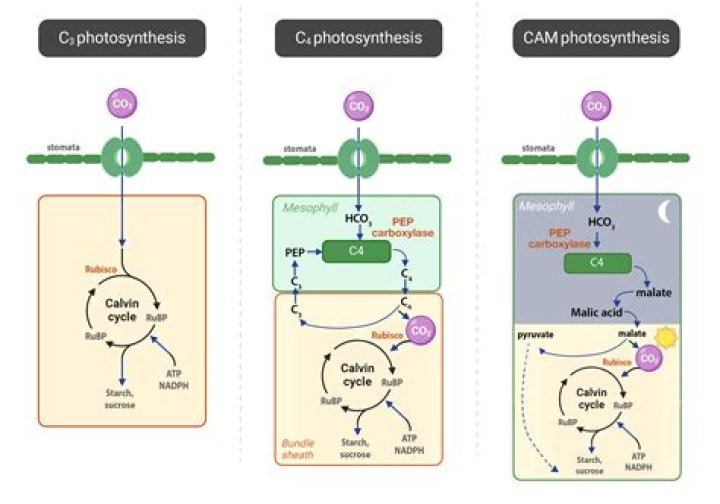
Similarities Between C3 C4 and CAM Photosynthesis Both the light reaction and the Calvin cycle occur similarly in each type of photosynthesis. However, they differ by the method of carbon fixation.
How are CAM and C4 plants similar?
What are the Similarities Between C4 and CAM Plants? C4 plants and CAM plants are present in the environments that have low water availability. Also, mesophyll cells are involved in both C4 and CAM carbon fixation pathways.
What is the difference between C3 C4 and CAM plants and how they do photosynthesis?
C3 photosynthesis produces a three-carbon compound via the Calvin cycle while C4 photosynthesis makes an intermediate four-carbon compound that splits into a three-carbon compound for the Calvin cycle. Plants that use CAM photosynthesis gather sunlight during the day and fix carbon dioxide molecules at night.
How are C3 and C4 leaves different?
C3 PlantsC4 PlantsC3 requires cool and wet environments.C4 requires tropical and dry environments.95% of the green plants are C3 plants.5% of the green plants are C4 plants.What is the difference between C3 C4 and CAM plants quizlet?
C3= 3 Carbon, C4= 4 Carbon. CAM= plants that only open stomata at night.
Do C4 and CAM plants photorespiration?
The majority of plants are C 3 \text C_3 C3start text, C, end text, start subscript, 3, end subscript plants, which have no special features to combat photorespiration. … Crassulacean acid metabolism (CAM) plants minimize photorespiration and save water by separating these steps in time, between night and day.
What are the plants that are generally associated to C3 C4 and CAM plants?
Most plants have C3 photosynthesis, eg. rice, wheat, barley and oats; tropical grasses for example are C4, sorghum, sugarcane and corn (maize); and CAM plants such as pineapple, agave and prickly pear cactus are found in very dry conditions.
What are CAM plants examples?
Examples of CAM plants include orchids, cactus, jade plant, etc. Compare: C3 plant, C4 plant. See also: Crassulacean acid metabolism, Calvin cycle.Why CAM plants are called night C4 plants?
CAM plants CAM are C4 plants that fix carbon dioxide during the night. They store it as 4 carbon malate, releasing carbon dioxide during daylight when the light dependent reactions of photosynthesis can take place. This allows the plants to survive in very hot, dry conditions.
Where are CAM plants found?Crassulacean acid metabolism (CAM) is a photosynthetic adaptation to periodic water supply, occurring in plants in arid regions (e.g., cacti) or in tropical epiphytes (e.g., orchids and bromeliads). CAM plants close their stomata during the day and take up CO2 at night, when the air temperature is lower.
Article first time published onWhich of the following process differentiate C3 and C4 plants?
Photorespiration is the light dependent process of oxygenation of ribulose biphosphate and release of carbon dioxide by the photosynthetic organs of a plant. … This process creates an important difference between C3 and C4 plants as it is absent in C4 plants.
How C4 plants Kranz anatomy is different than CAM plant?
These enzymes are active at different times, PEP carboxylase during the day and Rubisco at night. Just as Kranz anatomy is unique to C4 plants, CAM plants are unique in that the stomata are open at night and largely closed during the day. The biochemical pathway of photosynthesis in CAM plants begins at night.
What is the main difference between C3 and C4 carbon fixation quizlet?
C3 carbon fixation is the process used for most plants. In C3 carbon fixation, carbon dioxide first combines with a 3-carbon compound while in C4 carbon fixation, carbon dioxide first combines with a 4-carbon compound. Plant stomata are open during the day in both types of carbon fixation.
What advantage is it for some plants to use C4 and CAM photosynthesis?
C4 and CAM strategies both reduce photorespiration that occurs in a higher amount in C3 photosynthesis. They use phosphoenolpyruvate for the fixation of carbon dioxide. PEP does not react with oxygen that is the reason for reduced photorespiration in C4 photosynthesis.
What are the physiological and biochemical differences between C3 and C4 photosynthesis?
In C3 plants, the bundle sheath cells do not contain chloroplasts. In C4 plants, the bundle sheath cells contain chloroplasts. In C3 plants, the carbon dioxide fixation takes place only at one place. In C4 plants, the carbon dioxide fixation takes places twice (one in mesophyll cells, second in bundle sheath cells).
Why do leaves appear green?
Plants use glucose together with nutrients taken from the soil to make new leaves and other plant parts. … Chlorophyll gives plants their green color because it does not absorb the green wavelengths of white light. That particular light wavelength is reflected from the plant, so it appears green.
Do CAM plants have bundle sheath cells?
The similarity between the c4 and Cam plants have bundle sheath cells. … The C4 plant open stomata in the day, and the CAM plant open stomata at night time. The c4 and CAM plants use PEP for carbon fixation.
How is CAM photosynthesis different than C4?
The main difference between C4 and CAM plants is the way they minimize water loss. C4 plants relocate the CO2 molecules to minimize photorespiration while CAM plants choose when to extract CO2 from the environment. … C4 plants are typically summer plants like corn and sugar cane.
Is Nerium a CAM plant?
Nerium consists of sunken stomata, it is an adaptation seen to prevent water loss by transpiration. CAM plants like Nerium are mostly succulent xerophytes and here the stomata are present in small pit-like structures. … – Some other examples of plants showing CAM are Opuntia, Bryophyllum, Euphorbia, etc.
Are all succulents CAM plants?
CAM plants include many succulents such as Cactaceae, Agavacea, Crassulaceae, Euphorbiaceae, Liliaceae, Vitaceae (grapes), Orchidaceae and bromeliads. CAM plants take in carbon dioxide during the night hours, fixing it within the plant as an organic acid with the help of an enzyme.
What is C3 plant?
C3 plants are plants in which the initial product of the assimilation of carbon dioxide through photosynthesis is 3-phosphoglycerate, which contains 3 carbon atoms.
Is C4 a sorghum?
C4 plants dominate tropical grasslands and savannahs, and include the important crops – sugarcane, maize, and sorghum.
Is corn a C4 plant?
Examples of C4 plants include corn, sorghum, sugarcane, millet, and switchgrass. However, the C4 anatomical and biochemical adaptations require additional plant energy and resources than C3 photosynthesis, and so in cooler environments, C3 plants are typically more photosynthetically efficient and productive.
What is unique about CAM plants?
Since CAM is an adaptation to arid conditions, plants using CAM often display other xerophytic characters, such as thick, reduced leaves with a low surface-area-to-volume ratio; thick cuticle; and stomata sunken into pits. Some shed their leaves during the dry season; others (the succulents) store water in vacuoles.
How CAM plants do photosynthesis?
CAM photosynthesis is a CO2-concentrating mechanism that uses a C4 cycle of PEP carboxylation followed by C4 acid decarboxylation to concentrate CO2 around Rubisco (Figure 4). In CAM plants, stomata open at night when conditions are relatively cool and humid.
What is CAM pathway in photosynthesis?
Crassulacean Acid Metabolism (CAM) Photosynthesis In this pathway, stomata open at night, which allows CO2 to diffuse into the leaf to be combined with PEP and form malate. This acid is then stored in large central vacuoles until daytime.
How does carbon fixation differ between C3 and C4 plants?
How does carbon fixation differ between C3 and C4 plants? A. C4 plants undergo carbon fixation by carboxylation of a four-carbon substrate (oxaloacetate), while in C3 plants, a three-carbon compound (phosphoglycerate) is carboxylated.
How is the process of carbon fixation in CAM plants different from the process in C3?
Compare the process of carbon fixation in C3 plants to that of CAM plants. CAM plants are adapted to arid conditions, while C3 plants are adapted to areas with moderate light and temperatures. CAM plants convert carbon dioxide to acid and store it during the night.
Why are C4 and CAM photosynthesis more energetically expensive than C3 photosynthesis?
Why are C4 and CAM photosynthesis more energetically expensive than C3 photosynthesis? … These pathways avoid the photorespiration that consumes ATP and reduces the photosynthetic output of C3 plants when they close stomata on hot, dry, bright days. Hot, arid climates would favor C4 and CAM plants.